Jumat, 02 November 2012

Expresing Happines

Expressing Happiness

Expressing Happiness


1.      The Definition of Happiness Expression:

Happiness expression is an expression that is used to show that someone or people are glad have excited feelings.
What is happiness?
-It is important to first understand that the term “happiness” refers to the emotion, mood, and state of happiness; however researchers generally study the more enduring “state”.
-Expression happiness is used to express happiness feelings when we are successful to do something.
 2.      Expressing Happiness
Here are some expressions to show happiness
ü  That’s wonderful!
ü  That’s fantastic!
ü  That’s good!
ü  I find it very exciting.
ü  Good job!
ü  Great!
ü  Fantastic!
ü  Terrific!
ü  Hooray!
ü  Yippee!
ü  What a great idea!
ü  It sounds like fun.
ü  It is good news.
ü  I’m pleased/delighted about it.
ü  It’s the best thing I’ve heard …. (examples: ever, for a long time)
ü  I’m satisfied with ….
ü  Congratulations!
ü  I’m very happy because/on …. (examples: you success, your graduate)
ü  Well done.
ü  My life’s fun of happy day.
ü  You really make me happy.
ü  I like …. (example: to know that)
ü  I love …. (example: to hear that)
ü  It was great.
 Examples
Read the dialogs.
 ext 1
Hilal : Hi, Najmi! Haven’t seen you for a long time. How is it going?
Najmi : Oh, hi Hilal….. It’s great, thanks. How is everything with you?
Hilal : Well, I’m fine. As a matter of fact, I was promoted as a manager.
Najmi : Wow, that’s really great. I’m glad to hear that. I’m sure you will have a good career.
Hilal : Thank you. And how about you? I’ve heard you are a secretary now.
Najmi : Yes, you’re right. That’s what I want since I was young.
Answer the following questions.
1.Who are involved in the dialogue above?
2.What is the relationship between Hilal and Najmi?
3.Where does the conversation take place?
4.Who works as a secretary?
5.What does Najmi say to express her happiness?

Text 2
Najmi : Have you ever heard that Icha and Doni are getting married?
Hilal : Oh, really? What a surprise. I’m very pleased to hear that. When is the wedding?
Najmi : Next week. Will you come to their wedding party.
Hilal : Of course. How about you?
Najmi : I’ll go there with my husband. Well, if you want we can go there together.
Hilal : All right. Pick me up at 1.
Answer the following questions.
1.Who are involved in the dialogue above?
2.What is the relationship between Nico and Olga?
3.Where does the conversation take place?
4.When will the wedding party?
5.Who will come to the wedding party?


Advertisement

Advertisement

The definition of Advertisement:
Advertisement is promotion of goods, services, companies, and ideas that must be paid by a sponsor.
Function of Advertisement:
•          Promotion
•          Communication
•          Information
Language of Advertisement:
•          Using the correct or suitable words
•          Using positive expression
•          Using the interesting and suggestive expression
•          Text of advertisement should be directed to the goals
In making Advertisement, keep the following points:
•          The contents of advertisement must objective and honest
•          Short and clean
•          Does not allude other group or producer
•          Use word that polite and logical
•          Attract attention
Kinds of Advertisement:
•          Family advertisement

Expressing Simpthy

Expressing Sympathy


1. Definition
Sympathy expression is an expression or feeling of pity and sorrow when we know and see someone or people are unlucky or have trouble and in bad condition. By sympathy expression we want to show our concern of corefuiness or other people’s condition.
2. How to express sympathy
We express sympathy expression directly to him / her orally or use a letter or card by post also by short message service (SMS), television, radio, E-mail, and newspaper if he/she who go trouble is from use.
3. example of Expresing Sympathy :
 Example Dialogues
Person 1: I've been rather sick lately.
Person 2: I hope you feel better soon.
Person 1: Tim has been having a lot of troubles lately. I think he might be getting a divorce.
Person 2: I'm sorry to hear about Tim's problems. I hoe things get better for him soon.
It's also common to express sympathy in writing. Here are some common phrases you can use when writing a sympathy note to someone. Notice that is common to use the plural 'we' and 'our' when expressing written sympathy as a way to express that a family
My heartfelt condolences on your loss.
Our thoughts are with you.
She/he was a lot of things to many people and will

Invitation

Invitation Pronunciation


Definition of invitation

noun

  • a written or verbal request inviting someone to go somewhere or to do something: a wedding invitation
  • [mass noun] the action of inviting someone to go somewhere or to do something: a club with membership by invitation only a herb garden where guests can only go at the invitation of the chef
  • [in singular] a situation or action that tempts someone to do something or makes a particular outcome likely: tactics like those of the colonel would have been an invitation to disaster

    Inivitation

    INVITATION

    Invitation is the way to invite someone or more to go to place or to do something.
    Purpose is to invite someone or more to come to an event.
    There are two types of Invitation :
    1. Formal Invitation
    2. Informal Invitation
      1. Formal & Informal Invitation

    Formal invitation is usually originate from institutes, companies and a kind of it. Normally formal invitation is written invitation.
    Informal Invitation is personal invitation given to a friend, family, etc. Informal invitation can be written invitation and verbal invitation.

    2. Example of Formal Invitation
     
    STUDENTS ORGANITATION OF VOCATIONAL HIGHT SCHOOL TELECOMUNICATION OF SHANDY PUTRA BANJARBARU
    Jl. Panglima No. 17 telp.085386866301
    To  :Calista
      Class : X-3
      Would you please attend our meeting that will be held :
      Day/Date  : on Saturday 21th September 2012
      Time  : at 10.00 am
      Place  : in the meeting room
      Agenda  : Final preparation for speech.
      Please come on time, see you there !
       
    Hannah Anafelow                                        Elizabeth Mildford, M.Pd                                        
            Secretary                                                              Chair Person
      3. Example of Informal Invitation
    From  : yustien
    To  : rima
    Hi yus, tomorrow is my mother and father wedding anniversary . At my
    wedding anniversary, my parents 30 years old. And I would like you to come to my wedding anniversary:
      Date  : Appril 20th 2012
      Time  : 07.00 pm
      Place  : at my garden.
      I’ll be happy if you come to my wedding anniversary.
      
    4. Extending (Expressions of Inviting)
    Example :
    1.I would like you to come to my house?
    2.Would you like to come to my restaurant?
    3.How would you like to go camping with us next month?
    4.If you are not busy, please try to come to my office.
    5.Are you free this evening?
    6.Let’s go to the Jazz Festival!
    7.Can you come?
    8.Please try to come
    9.We hope you will join us
    10.If you don’t have any other plans, would you come to the café?


     5. Accepting an Invitation
    Example :
    1.I’d love to
    2.I like that
    3.That sounds great
    4.Thank you for the invitation
    5.That would be wonderful
    6.I’d be glad to
    7.That sounds like fun
    8.It’s very nice
    9.It’s sounds interesting
    10.All, Right!
    11.Thank you, I will come
    12.O.K!    
     6. Declining/Refusing
    Example :
    1.I’d love to, but I can’t
    2.I’m really sorry because I can’t come
    3.Sorry, I’m really busy
    4.I’d love to, but I won’t be able to
    5.I’d love to, but I don’t think I can
    6.Sorry, I can’t go with you
    7.Sorry, that would not be possible . Thanks anyway
     7. Dialogue of Invitation
     
    Dialogue of Accepting  Invitation :
    Natsu   : Would you like to go with me to  Gray’s birthday party?
    Lucy  : Sure. I’d like to.
    Natsu  : Great!!
    Lucy  : What time is the party?
    Natsu   : The party is at 07.00 pm, so I will                pick you up at 06.30 pm.
    Lucy     : Okay. Do I need to bring a present with me?  
    Natsu  : No, I’ll take care of it.
    Lucy  : Okay, then. See you. 

Appoinment

Appointment


1.      The Definition of Appointment 
Appointment is a kind of expression which is used to conduct an appointment.
2.      Expressions We Can Use to Make and Accept an Appointment
Here are some expressions we can use to make and accept an appointment.
Making an Appointment
1)     Will you pick me up at ….? (example: tomorrow morning 2 p.m.)
2)     What if we go ….? (examples: cycling on car free day next Sunday, swimming this afternoon)
3)     Will you go out with me ….? (example: tonight)
4)     I’ll go to …. (example: your house at 3 p.m.). It’s all right?
5)     I’d like to make an appointment with …. (examples: you, him, her)
6)     I want to make an appointment to see …. (examples: my dentist, my private teacher)
7)     I’d like you to come and see me.
8)     Can we meet at …. (examples: Kitchen Restaurant, Aquarius Hotel)
9)     Can I come and see you?
10)   What about …. (example: tomorrow afternoon at 4 p.m.)
Accepting an Appointment
1)     Okay. I’ll be there on time.
2)     No problem. I’m free …. (examples: on Sunday, at that day, at that time)
3)     Sure, I love it.
4)     Good idea.
5)     Definitely!
6)     All right, see you there.
7)     It is a deal.
8)     Sure.
9)     Why not?
3.      Expressions We Can Use to Cancel an Appointment
Here are some expressions we can use to cancel an appointment.
Cancel an Appointment
1)     I’m sorry. I can’t meet you today. I have to see my dentist. Can we reschedule?
2)     We’re terribly sorry we have to cancel our appointment. Mr. Tanaka’s flight is delayed for two hours.
3)     I’m afraid I have to put off put appointment because I have an urgent business to do.
4)     Sorry. I can’t meet you this weekend since I have another appointment.
5)     Sorry, I can’t meet you tomorrow. I’m busy at that day.
 Examples
Read the dialogs.

Dialog 1
Lehm    : Valmet, do you fancy going for lunch

Valmet  :  Yeah, why not ?
Lehm    : Er... after school at Bu Nita's food stall ?
Valmet  : Yes!

Lehm    : See you there then

Valmet  : See you

The sentences in bold are used to make and accept an appointment. In the dialog, Lehm makes an appointment with Valmet to have lunch in the BU Rita's food stall. Then, Valmet accepts the invitation by saying, “Yes”.

Dialog 2
Hidenori  : Tadakuni, can we talk for a second?

Tadakuni : Yes, sure. Is there something serious ?
Hidenori  : Yes. In fact I have to cancel our appointment this afternoon. I'm sorry, Tadakuni.

Tadakuni : That's O.K.
The sentences in bold are used to cancel an appoinment.

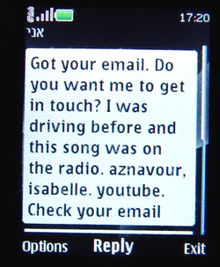
Message,personal Letter, Announcement

ANNOUNCEMENT, MESSAGE, AND PERSONAL LETTER

1. ANNOUNCEMENT 
An announcement is a public statement which gives information about something that has happened or that will happen

EXAMPLE


2. MESSAGE

 message is information which is sent from a source to a receiver. Some common definitions include:

    Any thought or idea expressed in a language, prepared in a form suitable for transmission by any means of communication.
    An arbitrary amount of information whose beginning and end are defined or implied.

In communication between humans, messages can be verbal or nonverbal:

    A verbal message is an exchange of information using words. Examples include face-to-face communication, telephone calls, voicemails, etc.
    A nonverbal message is communicated through actions or behaviors rather than words. Examples include the use of body language and the actions made by an individual idea.


MESSAGE


    SHORT MESSAGE
 (Short messaging) Short Message Service (SMS) is the text communication service component of phone, web or mobile communication systems, using standardized communications protocols that allow the exchange of short text messages between fixed line or mobile phone devices. ...

EXAMPLE
 
SHORT MESSAGE

3. PERSONAL LETTER

A personal letter is a type of letter which provides communication between a small number of people, usually two. There are many types of personal letters and they are written for a wide variety of reasons:
  • One person wishes to attain information from an individual or a business.
  • One person wishes to tell somebody about themselves, as in pen pals.
  • One person wishes to present to an individual or a business a social note, such as a thank-you or a congratulation.
  • One person wishes to communicate with an acquaintance - friend or family, for example in order to maintain and reinforce the bond between them.
Surviving personal letters are often an important source of information about the lives of historical figures.

example:

Greeting

GREETING
 

   Greeting is an act of communication in which human beings (as well as other animals) intentionally make their presence known to each other, to show attention to, and to suggest a type of relationship or social status between individuals or groups of people coming in contact with each other. While greeting customs are highly culture- and situation-specific and may change within a culture depending on social status and relationship, they exist in all known human cultures. Greetings can be expressed both audibly and physically, and often involve a combination of the two. This topic excludes military and ceremonial salutes but includes rituals other than gestures.
Greetings are often, but not always, used just prior to a conversation.
Some epochs and cultures have had very elaborate greeting rituals, e.g., greeting of a king.
Secret societies have clandestine greeting rituals that allow members to recognize common membership.
     
     A greeting can consist of an exchange of formal expression, a simple kiss, a hand shake or a hug. The form of greeting is determined by social etiquette, as well as by the relationship of the people.
Beyond the formal greeting, which may involve a verbal acknowledgment and sometimes a hand shake, facial expression, gestures, body language and eye contact can all signal what type of greeting is expected. Gestures are the most obvious signal, for instance greeting someone with open arms is generally a sign that a hug is expected.  However, crossing arms can be interpreted as a sign of hostility. Facial expression, body language and eye contact reflect emotions and interest level. A frown, slouching and lowered eye contact suggests disinterest, while smiling and an exuberant attitude is a sign of welcome.
   Throughout all cultures people greet one another as a sign of recognition, affection, friendship and reverence. While hand shakes, hugs, bows, nods and nose rubbing are all acceptable greetings, the most common greeting is a kiss, or kisses, on the cheek. Cheek kissing is most common in Europe and Latin America and has become a standard greeting in Southern Europe.
While cheek kissing is a common greeting in many cultures, each country has a unique way of kissing. In Russia, Slovenia, Serbia, Bosnia & Herzegovina, Macedonia, Montenegro, the Netherlands and Egypt it is customary to “kiss three times, on alternate cheeks.” Italians & Hungarians usually kiss twice in a greeting and in Mexico and Belgium only one kiss is necessary. In the Galapagos women kiss on the right cheek only and in Oman it is not unusual for men to kiss one another on the nose after a handshake. French culture accepts a number of ways to greet depending on the region. Two kisses are most common throughout all of France but in Provence three kisses are given and in Nantes four are exchanged. However, in Finistère at the western tip of Brittany and Deux-Sèvres in the Poitou-Charentes region, one kiss is preferred.


Everyday Greetings

 morning
English listening "Good morning."
 afternoon
English listening "Good afternoon."
 evening
English listening "Good evening."
Goodbye
English listening "Goodbye."
night
+
Goodbye
English listening "Good night."
night
+
bed
"Good night."

Go to top of page

Special Greetings

Santa Claus English listening "Happy Christmas." or English listening "Merry Christmas."
00.01 - 1st January English listening "Happy New Year!"
Easter English listening "Happy Easter."
drivetest or Testetc.... English listening "Good Luck!"
PassTest orGraduation etc... English listening "Congratulations!" or English listening "Well done!"
Get well English listening "Get well soon."